
Cartersville Directory Collections
The strongest Cartersville historical shelf is at the Bartow History Museum's Mulinix Research Center. Its inventory confirms city directories, telephone books, newspapers, court files, funeral-home records, obituaries, oral histories, maps, and genealogy files. The museum does not publish exact local-directory titles, publishers, inclusive years, or missing volumes online. Ask for a shelf list before treating any year as available.
| Collection | Verified years | Where held | Access |
|---|---|---|---|
| Cartersville city directories | Exact run not published | Mulinix Research Center | On site or staff request |
| Telephone directories | 1940s through 1990s | Mulinix Research Center | On site or staff request |
| Bartow newspapers | Most years 1868 through 2015 | Mulinix Research Center | On site or staff request |
| Court records | 1840s through 1920s | Mulinix Research Center | Research collection |
| Marriage files | 1866 through 1927 | Georgia Archives | Unrestricted microfilm |
| Vertical files | Many items date 1850 through 1880 | DLG and museum | Free digital discovery |
A missing title is a research gap, not proof that no directory was printed. Rural delivery, unlisted phone service, preservation gaps, and uneven indexing can remove a household from one volume. Record the title, year, page, and repository for each find.
Cartersville Directory Desk at Mulinix
The Research Center is at 1 N. Gilmer St. and reports weekday hours of 10 a.m. to 4 p.m., except major holidays. The archivist accepts requests at 770-382-3818 ext. 7353 and smcbride@bartowhistorymuseum.org. Mail goes to Bartow History Museum, 4 E. Church St., Cartersville, GA 30120. Ask about copy cost and permission before ordering images.
Give the person's full name and variants, an approximate year, any known address, and the item sought. Ask whether the volume has a surname section, street-order section, householder index, abbreviation page, and gaps. If staff cannot confirm a volume, widen the request to telephone books, newspapers, funeral-home records, or vertical files for the same date.
Archive tip. Copy the title page and abbreviation key before the entry, since both control how the listing should be read.
Reading Cartersville Directory Entries
No authoritative scanned Cartersville directory page was found online, so a local abbreviation key must control the reading. Period directories often list surname, given name, spouse, occupation or employer, and home address. Some use “h” for home, “r” for resides or rooms, and “wid” for widow. These are common conventions, not verified Cartersville rules.
| Name | Copy spelling, initials, and ordering exactly. |
|---|---|
| Spouse | A parenthetical name may separate two same-name people. |
| Work line | Occupation or employer may link an entry to local files. |
| Address | Preserve house number, street spelling, and directional marks. |
| Status mark | Check the key before reading home, room, or widow abbreviations. |
- Criss-cross directory
- A street-and-number section. Its presence in Cartersville volumes is not verified.
- Householder index
- An address-order list used to identify a person shown at a dwelling.
- Abbreviation key
- The publisher's list of shortened terms, symbols, and entry rules.
The entry is dated evidence. A person may have moved between canvass and print dates, while women, renters, boarders, and rural residents may have been recorded unevenly.
Cartersville Telephone Directory Years
The museum confirms telephone directories from the 1940s through the 1990s. That run can bridge gaps when the historical shelf lacks a year. A phone book may show a subscriber and address, but it does not list every household member. Unlisted numbers, shared lines, name conventions, and service changes limit what absence means.
Search several years on both sides of the target date. A first and last appearance form a range, not exact move dates. Compare the result with a census, deed, marriage, probate, or dated newspaper notice. For current address-keyed sources, use the Cartersville street directory workflow instead of projecting an old listing into the present.
Note: A telephone subscriber can be tied to an address without proving ownership or naming each person who lived there.
Cartersville Newspapers Bridge Directory Gaps
The Mulinix newspaper holdings cover most years from 1868 through 2015, a long local span. Newspapers can explain why a name vanishes from a directory through an obituary, marriage notice, move, sale, school item, or civic report. They may also supply initials and relatives that distinguish same-name residents.
Start with the narrow date range made by adjacent directory entries. Search spelling variants and initials, then save the newspaper title, issue date, page, and exact relationship stated. Social columns are leads, not final proof. Confirm a death through a vital record, a transfer through the deed, and an estate relationship through probate.
This source makes Cartersville city directory research more than a shelf lookup. It creates a dated chain across print sources while keeping each source's limits clear.
Atco Families in Cartersville Records
The museum holds the Wingfoot Clan, Atco Edition for most years from 1929 into the 1990s. This publication can add names tied to Atco events, schools, clubs, marriages, and obituaries that a general general local directory may miss. It is one of the city's most distinctive family-history resources.
Use a dated newsletter item to form a question, then corroborate it. A club mention does not establish residence. A marriage or obituary notice may identify relatives, but names still need support from official marriage, death, probate, or deed records. The Etowah Valley Historical Society inventory offers another route into local industry, churches, people, places, and events.
Note: “Most years” permits gaps, so ask staff to confirm the exact Atco issue before planning a visit.
Digital Cartersville History Files
No authoritative open scan of a full local directory volume was verified. Related sources are online. The Digital Library of Georgia project description says museum vertical files include original grants and deeds, many dating from 1850 through 1880, with some items not known elsewhere. Those files connect people, land, churches, schools, businesses, cemeteries, and civic groups.
Open the UGA account of the digitized Bartow collection before searching.
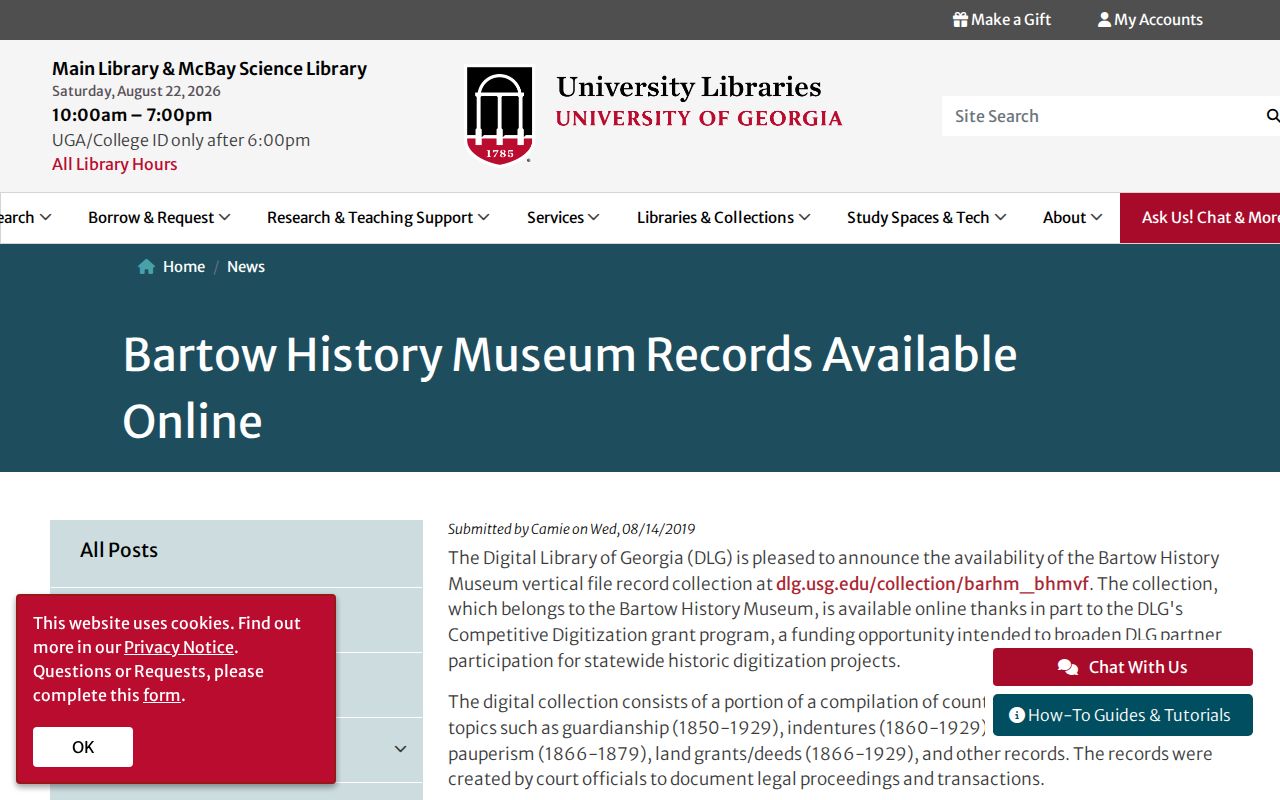
The files are companions, not substitutes for a directory. Cite each item and date, then return to the museum shelf when a surname or address entry is needed.
Map Cartersville Directory Addresses
The Library of Congress May 1895 Sanborn set has three free public-domain sheets for Cartersville. Sanborn maps show building footprints, use, materials, and street layout. They do not name residents. Pair a mapped structure with a directory address and deed owner.
| Era | Source | Best use |
|---|---|---|
| 1832 | Cass County land-lottery setting | Find early grant terms |
| May 1895 | Three Sanborn sheets | Locate a building footprint |
| 1900 through 1950 | Public federal censuses | Check households by decade |
| 1940s through 1990s | Telephone directories | Bridge directory gaps |
Early searches should include Cass County. The county formed in 1832 and took the Bartow name in 1861, so old catalog records may not use the modern label.
Trace Cartersville Directory Families
A sound family trail preserves what each dated source says. Directory years narrow moves between public federal censuses from 1900 through 1950. Individual 1960 schedules remain closed until 2032. A missing listing alone cannot prove death or departure.
- Choose a known year and copy the complete entry, page, title, and key.
- Check adjacent available years for the first and last appearance.
- Use a street section only if staff confirms one exists.
- Compare the census household while keeping owner, occupant, and subscriber roles distinct.
- Use newspapers, marriage files, probate, or deeds to explain a change.
The Georgia Archives Bartow marriage finding aid covers unrestricted files from 1866 through 1927. It is arranged by groom surname, while electronic text can help find a bride. Ask for the cited microfilm rather than assuming the aid is the full record.
Cartersville historical directories are strongest as dated evidence. Mark uncertain readings and let an independent source confirm or reject them.